
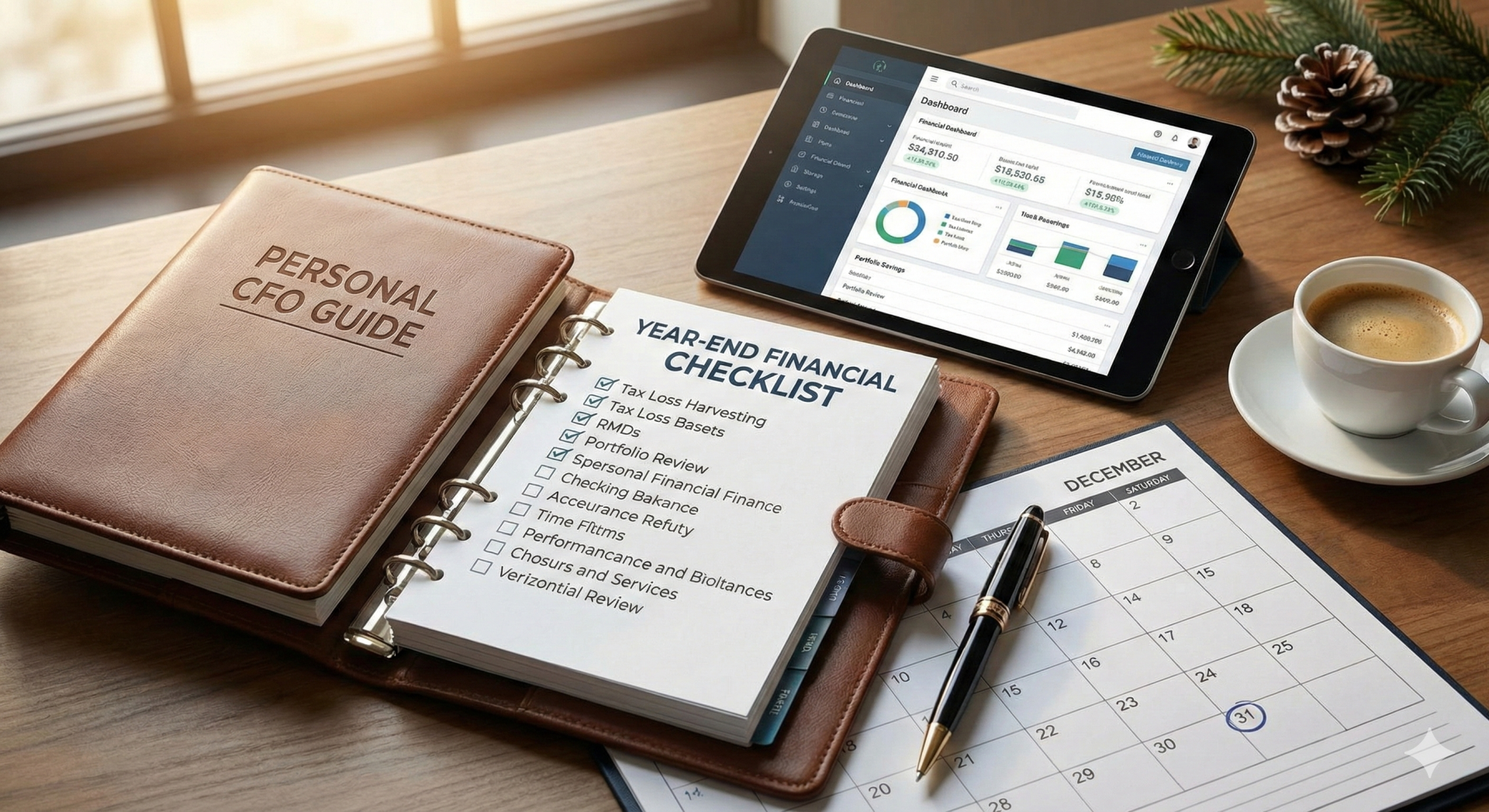
April Is for Filing. December Is for Planning.
Most people think of “tax planning” as something that happens in April. But by the time you sit down to file your return in the spring, the game is already over. The year has closed. You are simply reporting history.
True financial stewardship happens now, in the final weeks of the year.
As your Personal CFO, we believe in being proactive, not reactive. While the holiday season is busy, it is also the critical window for making strategic moves that can lower your tax bill and align your portfolio with your life goals.
To help you navigate this season with confidence (and without the stress), we have compiled this essential Year-End Financial Checklist.
1. Execute Your Roth Conversions (Deadline: Dec 31)
This is the most time-sensitive item on the list. If you are planning to convert pre-tax IRA funds to a Roth IRA, the funds must leave your account by December 31. You cannot do this “retroactively” in April like you can with an IRA contribution.
Why do this now? If your income was lower this year—perhaps you retired, or had a business slowdown—you might be in a “tax valley.” Filling up your lower tax brackets with a Roth Conversion can save you thousands in future taxes.
Note: We discussed the mechanics of this strategy in another post on Roth Conversions.
2. Satisfy Your RMDs (But Don’t Just “Take the Cash”)
If you are age 73 or older, you likely have a Required Minimum Distribution (RMD) that must be taken from your IRA before year-end. The penalty for missing this used to be 50%, and while it has been lowered, it is still a mistake you want to avoid.
However, you don’t necessarily have to take the cash and pay the tax.
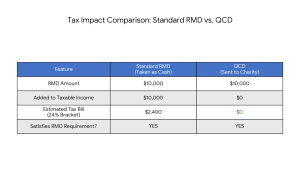
If you are charitably inclined, consider a Qualified Charitable Distribution (QCD). This allows you to send funds directly from your IRA to a charity. The money counts toward your RMD, but it is excluded from your taxable income. It’s a win-win: you support a cause you value, and the IRS doesn’t touch a dime of it.
3. Harvest Your “Lemons” (Tax-Loss Harvesting)
Even in a good year, not every investment goes up. If you have positions in your taxable brokerage account that are currently at a loss, you have an asset.
By selling these positions to realize a loss, you can use that loss to offset other capital gains. If you have more losses than gains, you can even use up to $3,000 of the excess loss to offset your ordinary income (like your wages or pension).
This is the “lemonade” of the investment world. It allows us to lower your tax bill without changing your long-term investment strategy.
4. Top Off Your Accounts (529s, HSAs, and Gifting)
Finally, December 31 is the deadline for several “use it or lose it” opportunities.
-
529 Education Plans: In many states (like Missouri), you must make your contribution by year-end to claim the state income tax deduction.
-
Annual Exclusion Gifting: For 2025, you can gift up to $19,000 to any individual tax-free. You cannot “carry over” this allowance to next year. If you plan to help children or grandchildren, doing so before Dec 31 utilizes this year’s cap.
-
Health Savings Accounts (HSAs): While you technically have until April to contribute, funding your HSA now ensures you maximize your tax deduction for the current year.
Proactive Tip: You can verify the current contribution limits for retirement accounts on the IRS website to make sure you’re on track for next year.
Peace of Mind for the Holidays
Ultimately, this Year-End Financial Checklist isn’t just about math. It’s about “Metanoia”—a shift in perspective.
When you know your RMDs are done, your taxes are optimized, and your gifting is complete, you can enter the holiday season with true financial peace. You stop worrying about the markets and start focusing on what truly matters: your family, your faith, and your values.
Take the Next Step
As your Personal CFO, managing these deadlines is part of the proactive planning we do every day. If you’d like to ensure your year-end plan is watertight, please feel free to schedule an intro call.