

Your Financial “Drift” and the Need for Rebalancing
If you’ve checked your account recently, you’ve seen that U.S. stocks have been the undisputed champion of the global market. When a core part of your plan grows this fast, it can cause your portfolio to “drift” away from its original risk target. This drift is why a disciplined portfolio rebalancing strategy is so essential.
Your investment plan might have started with a strategic target: say, 70% in U.S. equities and 30% in International. After years of U.S. outperformance, that 70% may have grown to 80% of your holdings.
As a result, your plan’s original “recipe” is out of balance. You are unknowingly taking on more concentrated risk than you originally intended.
The “Metanoia” Shift: What Is Portfolio Rebalancing?
When it’s time to rebalance, the most common emotional reaction is:
“Why would you sell my best-performing asset (U.S. stocks) to buy the ones that are lagging (International)?”
This is the classic trap of performance-chasing. It’s the “Old View.”
The “New View”—our “Metanoia”—is to see portfolio rebalancing for what it is: a powerful risk-management tool, not a market-timing strategy.
We aren’t selling the U.S. because we predict it will do poorly. We aren’t buying International because we predict it’s about to surge. We are rebalancing because we don’t have a crystal ball.
Diversification means we admit we don’t know which asset class will lead or lag. Portfolio rebalancing is the mechanical process of enforcing that discipline. It’s a systematic way to:
- Sell High: We trim the asset class that has done well (U.S. stocks), locking in those gains.
- Buy Low: We use those proceeds to buy the asset classes that have underperformed (International/Emerging), effectively buying them “on sale.”
This is the only way to mechanically obey the oldest rule in investing.
How Portfolio Rebalancing Manages Risk
Here is a simple visual of what “Portfolio Drift” looks like and how rebalancing corrects it. This portfolio started with a 70/30 (US/Intl) target, but U.S. stocks grew faster, “drifting” it to an 80/20 mix. Rebalancing brings it back to the strategic target.
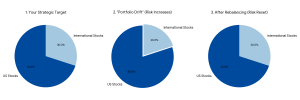
That “drifted” 80/20 portfolio is, by definition, less diversified and more dependent on the fortunes of a single country. Rebalancing simply brings your portfolio back in line with the original risk-and-return “recipe” we designed in your financial life plan.
Your Personal CFO and a Proactive Rebalancing Strategy
This is not a “set it and forget it” process. As your Personal CFO, we monitor this for you.
- Systematic Monitoring: We follow a systematic process to rebalance. This can be on a set schedule (like annually) or when an asset class “drifts” past a certain tolerance band.
- Tax-Smart Rebalancing: This is key. We don’t just sell blindly. If possible, we rebalance in the most tax-efficient way. This might mean:
- Using new cash or dividends to buy the under-performing assets.
- Selling the “winners” inside your tax-deferred accounts (like an IRA) where there is no tax impact.
- Strategically harvesting losses, if any, to offset gains.
This process is the very definition of financial stewardship. It’s disciplined, unemotional, and focused on the long-term health of your plan, not the short-term noise of the market.
Take the Next Step
This disciplined, proactive approach is at the heart of our “Personal CFO” model. If you’re ready for a new perspective on how your finances are managed, we invite you to schedule a ‘Fit Call’.