
As a high-earning professional, you know that saving money is important, but true wealth is built through the invisible engine of compound interest. But how do you actually measure the speed of your wealth creation without logging into a complex spreadsheet? The answer is a powerful mental model known as the Rule of 72.
As your Personal CFO , my goal isn’t just to manage your investments, but to help you experience a “Metanoia”—a fundamental change in how you perceive your money. When you understand the math behind compounding, market volatility becomes less terrifying, and the motivation to save becomes incredibly clear.
Here is how this simple formula can completely change your perspective on wealth accumulation.
What is the Rule of 72?
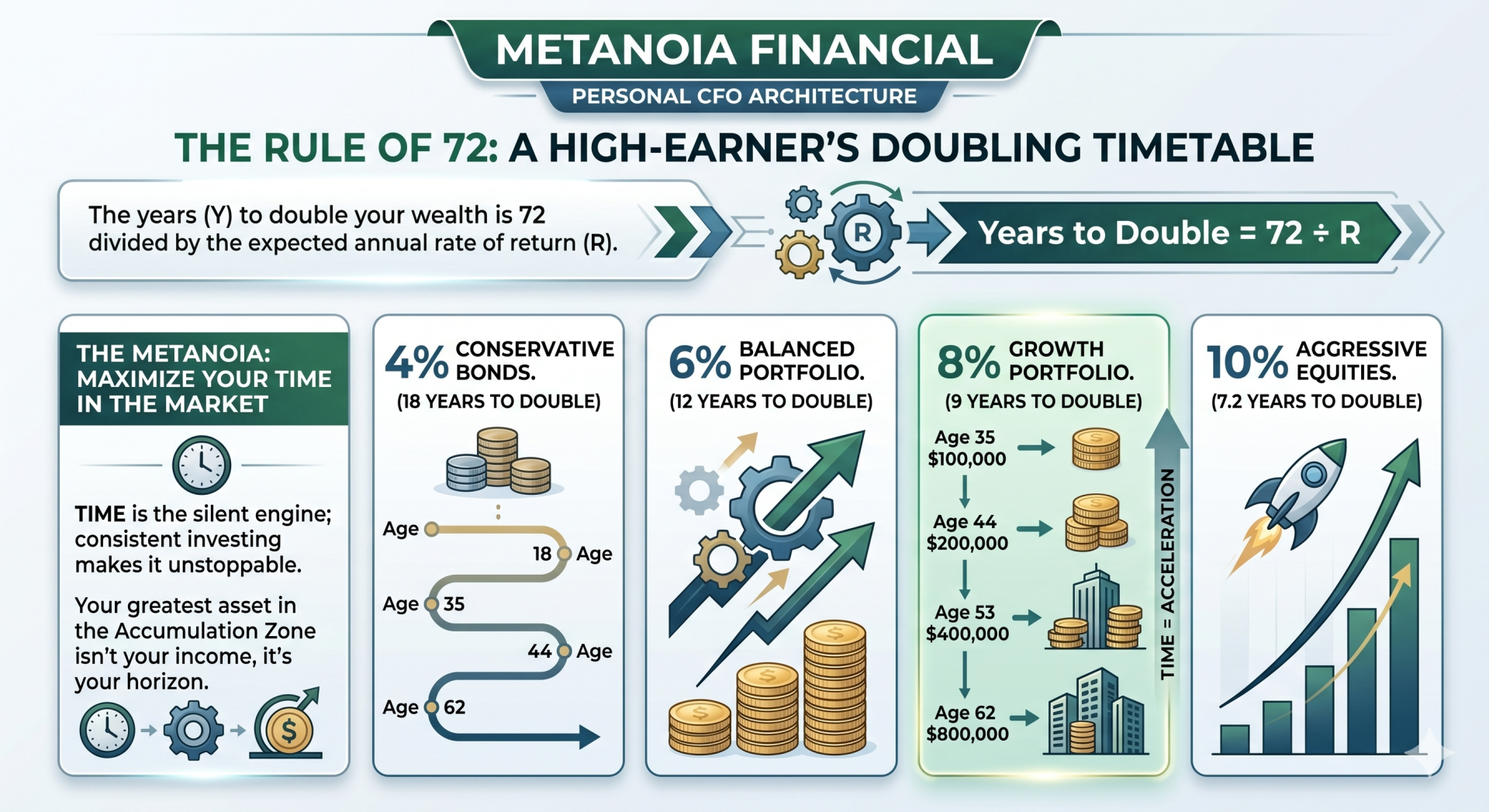
The Rule of 72 is a mathematical shortcut used to estimate how long it will take for an investment to double in value based on a fixed annual rate of return.
You simply divide the number 72 by your expected annual rate of return. The result is the number of years it takes to double your money. You can read more about the origins of this formula in Investopedia’s Guide to the Rule of 72.
The Formula: 72 ÷ [Annual Rate of Return] = Years to Double
If you assume a conservative average annual return of 8% on a diversified stock portfolio, the math looks like this:
72 ÷ 8 = 9 Years
This means that every 9 years, your invested capital will double without you lifting a finger.
The Doubling Timetable
To illustrate why this matters, look at how small differences in your rate of return drastically alter your timeline.
| Annual Rate of Return | Years to Double Your Money |
| 4% (Conservative Bonds) | 18 years |
| 6% (Balanced Portfolio) | 12 years |
| 8% (Growth Portfolio) | 9 years |
| 10% (Aggressive Equities) | 7.2 years |
The Metanoia: Why the Rule of 72 Matters for High Earners
When you are in the Accumulation Zone, your greatest asset isn’t the size of your current portfolio; it is your time horizon.
Imagine you are 35 years old and have accumulated $100,000 in your retirement accounts. If you never contribute another dime, but that money grows at an 8% average return, the Rule of 72 dictates it will double every 9 years:
-
Age 35: $100,000
-
Age 44: $200,000
-
Age 53: $400,000
-
Age 62: $800,000
By simply leaving the money alone, that initial $100,000 turns into $800,000 by the time you reach standard retirement age.
Beating the “Silent Thief”
We regularly warn our retiree clients about the dangers of inflation. The Rule of 72 works in reverse, too. If inflation averages 3% a year, the purchasing power of your cash will be cut in half in 24 years (72 ÷ 3 = 24). If your money is sitting in a checking account earning 0%, you are guaranteeing a loss of purchasing power. You have to invest just to tread water.
Automating the Rule of 72
The math only works if the money is actually invested. As we have discussed in our guide to Automated Wealth Building, relying on willpower to invest your leftover cash rarely works.
Your job is to focus on your career and your family. Our job, as your Personal CFO, is to build the automated systems that continuously feed your portfolio, allowing the Rule of 72 to run quietly in the background.